 Von Robert Brendler · 2026-10-03
The gap between shipping code and understanding it
Zusammenfassung
AI agents allow teams to ship changes faster, but this speed often masks a loss of human comprehension regarding why those changes work. Leadership must distinguish between the evidence of a process and the actual understanding of the system.
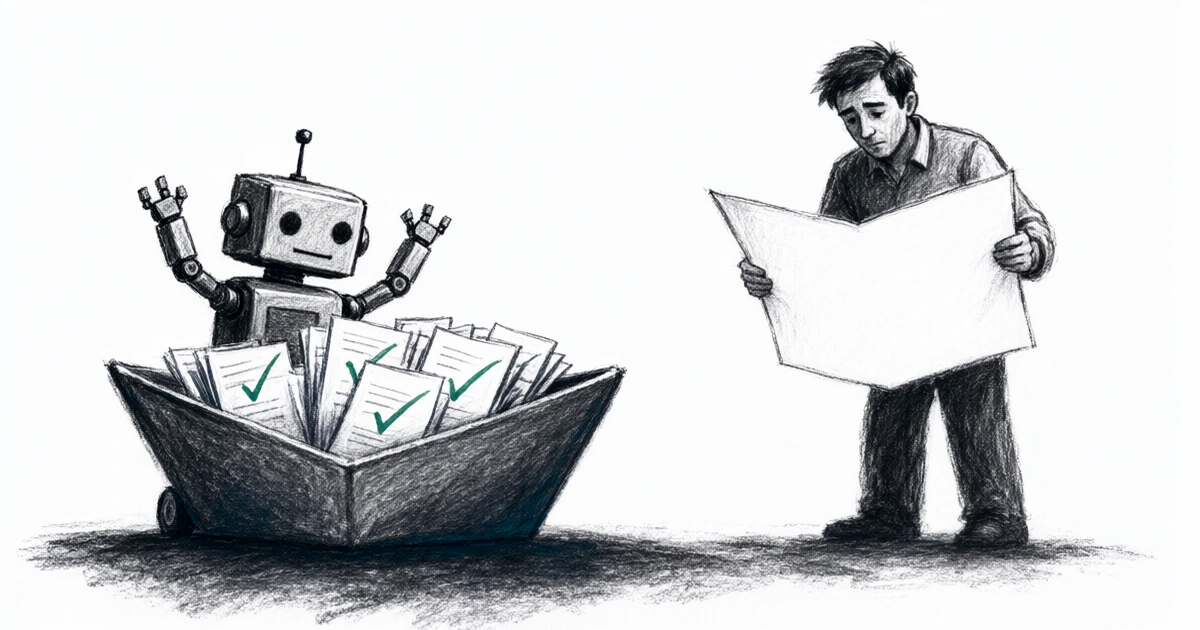
A team can ship a change without understanding why it works1.
AI agents split the act of producing code from the act of comprehending it1. Before these tools, writing code, reviewing it, and investigating failures forced engineers to spend time inside the problem1. This effort built a mental model of the system1. Now, models generate code, tests, and documentation with far less human contact1. Output scales, but understanding does not necessarily scale with it1.
The illusion of health
Dashboards can look fine while nobody can explain a failure1. In one scenario, a consequential change failed, but the rollback was quick and the service level objective (SLO) was not breached1. The error budget, which measures allowed downtime, showed the service was healthy1. However, during the after-action review, the engineering team could not explain why the change caused the failure1. They could show the approval chain and test results, but the explanation was missing1.
This reveals a gap in understanding that traditional metrics do not capture1. The error budget prices failure, but it does not measure comprehension1. When teams rely on AI to produce artifacts, the evidence of the process remains, but the human insight often disappears1. Fewer people on the team hold a mental model of the system, even as they ship more often1.
Three different proofs
The boundary between a demo and a production system is mutation2. An agent that only reads data is safe; an agent that changes state requires strict controls2. In production, approval, execution, and completion are three distinct facts2. A tool can run successfully without solving the operational problem2. A confirmation box looks like authorization, but it is not2. A successful API response looks like proof, but it is not2. A completed rollback looks like a resolved incident, but it is not2.
To manage this, leaders must treat the harness—the infrastructure around the agent—as a control plane2. This involves five contracts: context, state, tools, control, and completion2. These contracts ensure that the chain of evidence is preserved2. They define who approved an action, what identity executed it, and whether the goal was actually reached2. Without these, an agent’s actions are opaque, and the organization loses the ability to verify its own work2.
Bevor Sie danach handeln
Verify that your team can explain the 'why' behind shipped changes, not just the 'what'.
Quellen
- Your error budgets don’t know AI exists (LeadDev, 2026-09-30)
- Your agent loop is not a production system (LeadDev, 2026-09-28)